

A crane ready to lift on an offshore platform. The load is hooked, the operator initiates the maneuver — and suddenly the onboard display shows a fault: signal loss on the slewing axis. The machine stops. The entire operation stops with it. In most cases, the cause is not a complex electronic failure. It is a non-certified industrial connector for heavy equipment that gave way under vibration, or a sensor that stopped reading correctly.
Industrial connectors for heavy equipment are not simple electrical accessories. Together with sensors and wiring harnesses, they are the least visible but most critical components on a crane or lifting machine — the real communication line between safety systems and the machine itself. In this guide, we cover how to select them, where they most commonly fail, and when it pays to replace them with certified spare parts.
Why heavy duty connectors for off-highway machines cannot be standard parts
A standard connector designed for a passenger vehicle works in controlled conditions: moderate temperatures, limited vibration, a relatively clean environment. A construction crane, telescopic handler, or excavator operates in a radically different scenario. For this reason, heavy duty connectors for off-highway machines follow separate technical specifications — engineered specifically for harsh industrial and marine environments.

Vibration, harsh agents and thermal Shock: the environment of lifting machines
During daily operations, a lifting machine is exposed to three main stress factors. Whether operating on a land jobsite, an offshore platform, or a heavy industrial port, these are conditions that no generic connector is built to tolerate.
- Continuous structural vibration tends to progressively loosen uncertified connectors. As a result, contact resistance increases and the signal becomes unstable. In the worst cases, this leads to a total loss of communication between onboard systems.
- Hydraulic oils, salt spray, chemicals, and marine aerosol also penetrate connectors without adequate sealing. The outcome is contact oxidation — one of the most frequent causes of intermittent electrical faults on cranes and lifting machines operating in industrial and offshore environments.
- Finally, thermal cycling — from sub-zero winter starts to over 50°C cab temperatures in summer, compounded by constant humidity in marine environments — fatigues the polymer materials inside connectors. Over time, this continuous cycle can cause microfractures and progressive performance degradation.
IP67 Connectors for construction equipment and offshore cranes: minimum requirements
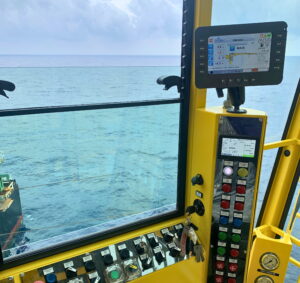 For a connector destined for crane or heavy equipment use, certain technical requirements are non-negotiable:
- IP67 or IP69K rating: certified protection against dust, temporary immersion, and high-pressure wash-down cycles
- Vibration resistance to recognised industrial standards such as MIL-STD-1344
- Tin or gold-plated contacts to limit oxidation in high-humidity and salt-spray environments
- Certified operating temperature, typically from -40°C to +125°C in the most robust industrial versions
A connector that meets these parameters significantly reduces the risk of unplanned machine downtime — an advantage that becomes critical in systems powering active safety devices.
PUR Cable for industrial wiring: the essential complement to certified connectors
A certified connector is not enough if the cable it is attached to was not designed for the same environment. PUR cable for industrial wiring and heavy equipment wiring harnesses is the standard for crane and lifting machine installations: it resists oils and hydrocarbons, maintains flexibility down to -40°C, and does not degrade under prolonged UV exposure — unlike standard PVC cables.
PUR cable also offers significantly higher abrasion resistance at contact points with metal structural parts, a detail that substantially extends the service life of the entire wiring harness on heavy equipment.
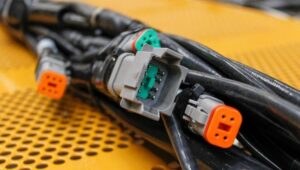
Custom Wiring harness vs. Generic cables: why assembly quality matters
Having certified PUR cables is not sufficient if the wiring harness assembly — terminal crimping, connector termination, cable gland management — is not carried out to manufacturer specifications. An incorrectly crimped terminal introduces a contact resistance that grows under vibration, generates heat, and leads to connection failure before the cable sheath shows any visible sign of wear. For this reason, crane sensor wiring for off-highway machines must be designed, assembled, and tested as an integrated system — not as a simple sum of individual components.
Types of Industrial Connectors for Heavy Equipment: selection criteria
Alongside automotive-grade connectors, cranes and lifting machines use a range of industrial connector families with specific construction characteristics based on the circuit they serve. Choosing the right type depends on the function the connector must perform onboard.
M23 Circular industrial connectors
M23 circular industrial connectors are among the most widely used in crane and lifting machine control systems. The cylindrical body and bayonet or threaded locking system provide excellent resistance to mechanical stress. They also deliver reliable IP sealing even after multiple connection and disconnection cycles — a key advantage during scheduled maintenance operations where connectors are regularly mated and unmated.
Multipole industrial connectors and industrial ethernet connectors
When a single wiring run must carry multiple signals simultaneously, multipole industrial connectors are the solution. These components handle dozens of contacts within a single compact body. Industrial ethernet connectors, on the other hand, come into play in more advanced onboard systems — where cameras, displays, and control units communicate via high-speed data protocols. In both cases, IP certification and mechanical resistance remain non-negotiable requirements for any off-highway or offshore application.
Sealed connectors for cranes: the off-highway standard
Among all connector families used on cranes and heavy equipment, sealed heavy duty connectors — such as the widely adopted Deutsch DT Series — have become the de facto industry standard for off-highway applications. Available in 2 to 12-way configurations, with a secondary locking system that prevents accidental disconnection from vibration or impact, these connectors are used primarily in circuits powering safety-critical sensors — where an unexpected disconnection is simply not an acceptable outcome.
When selecting certified replacements, 3Bmust supplies compatible components verified for integration with crane safety systems.
Hydraulic Pressure Transducer for cranes: function and fault signals
The hydraulic system of a crane is the heart of the lifting movement. Monitoring its pressure in real time is therefore essential — and this is where the hydraulic pressure transducer for cranes becomes a critical component. It continuously measures circuit pressure and transmits the value to the control unit, feeding the data chain that governs safe lifting operations.
What a hydraulic pressure transducer does on a crane
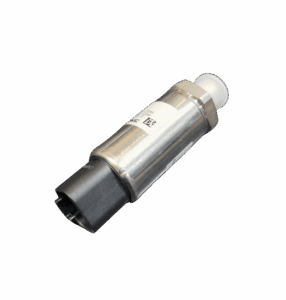 The crane hydraulic pressure transducer converts fluid pressure into an electrical signal readable by the onboard system. This data feeds, among other things, the crane load moment indicator (LMI). As pressure rises, so does the calculated lifted load. Through this calculation, the system determines in real time whether the load falls within the machine’s rated capacity for the current configuration.
A transducer designed specifically for crane use — unlike a generic pressure sensor — integrates thermal compensation and a corrosion-resistant stainless steel body. These features ensure measurement accuracy even after years of continuous jobsite or offshore operation. The 3Bmust 350 bar pressure transducer is an example of a component engineered specifically for these high-pressure off-highway conditions.
How to recognise a faulty hydraulic pressure sensor on a crane
A transducer losing accuracy rarely stops working all at once — more often, the signal begins to drift gradually. There are three main warning signs to monitor. The first is unstable pressure readings during constant-load maneuvers. The second is overload alarms triggering without apparent cause. The third is a discrepancy between the sensor reading and an independent reference pressure gauge. If any of these symptoms appear, verify the transducer before investigating any other system component.
Hall Effect Sensors for Cranes: boom angle and non-contact measurement
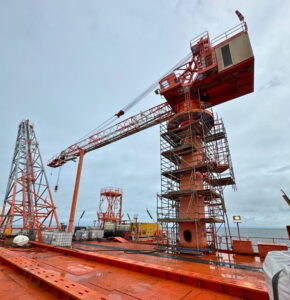 In addition to pressure, many cranes and telescopic handlers use Hall effect sensors to detect boom angle, rotation speed, and mechanical proximity — without any physical contact with the target.
This is their fundamental advantage: no moving parts inside the sensor means no mechanical wear over time.
Hall effect sensors for crane boom angle measurement are installed on the telescopic or luffing boom to provide the critical angular input for overturning moment calculation. They are also used on proximity limit switches that signal when end-of-travel positions have been reached.
When not certified for off-highway or offshore use, however, Hall effect sensors are vulnerable to moisture infiltration into the housing and signal drift caused by prolonged vibration — two failure modes that, on a safety-critical sensor, cannot go undetected or deferred.
Anti Two Block Switch for cranes: the device that prevents hook collision
Among the most critical safety devices on any crane, the anti two block switch stands apart. Its function is to prevent one of the most serious accidents in lifting operations: two-blocking — the collision of the hook block with the boom tip sheave during hoist-up. The consequences of a two-block event range from structural damage to catastrophic rope failure.
How the anti two block switch works on a Crane
T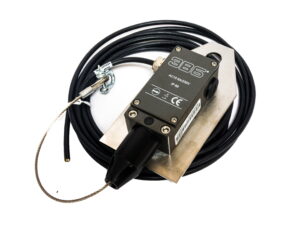 he crane anti two block switch detects the limit position of the hook and automatically interrupts the hoist-up command before impact occurs. The most widely used mechanism combines a spring system with a normally-closed microswitch. This way, any circuit anomaly — including a cable break — still generates a safety stop, rather than a missed intervention. A two-block switch that fails to intervene is not a maintenance issue: it is a safety incident waiting to happen.
The 3Bmust anti two block switch with plate (AC15 6A/230V) is compatible with the vast majority of cranes on the market and integrates directly with load limiting systems. Applicable safety regulations classify the anti two block switch as a mandatory active safety device: its operational integrity is non-negotiable.
When to replace the anti two block switch on a crane
The internal microswitch has a declared service life measured in opening and closing cycles. Once that limit is reached, replacement is mandatory — not a maintenance decision to be evaluated. The same applies in the presence of anomalous signals such as false stops or missed detections. As a crane active safety device, the anti two block switch is not subject to deferred maintenance under any circumstances.
Crane Load Moment Indicator: where connectors and sensors converge
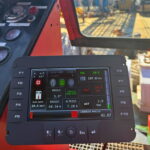
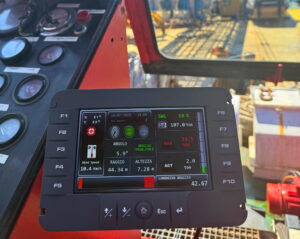
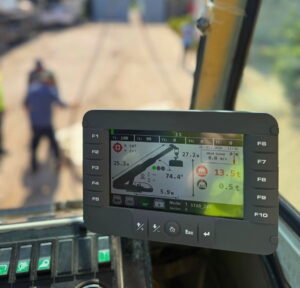
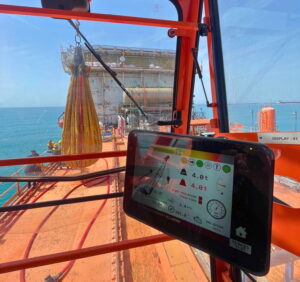 The crane load moment indicator (LMI) — also referred to as rated capacity indicator (RCI) — is the system that collects data from all onboard sensors: hydraulic pressure, boom angle, and extension. It processes this data to calculate the lifted load in real time and compare it against the machine’s rated capacity chart.
The reliability of the crane LMI therefore depends directly on the quality of the connectors and sensors feeding it. An unstable contact or an inaccurate pressure transducer can generate false alarms even when the LMI calculation system itself is functioning correctly.
For a detailed look at LMI operation, applicable regulations, and system selection, we have published a complete guide to crane LMI systems.
Crane Electrical Faults Troubleshooting: the most common patterns
Knowing the most frequent failure patterns in crane electrical faults troubleshooting helps to intervene before a minor issue becomes a full machine stoppage. Here are the most common situations encountered in the field.
- Intermittent signal from a sensor. If a sensor produces unstable or discontinuous readings, the probable causes are generally three: contact oxidation, a microfracture in the cable near a rigid fixing point, or moisture infiltration into the sensor housing. In all three cases, replacement with a certified component resolves the problem at the root.
- Loss of control on one axis. When an axis responds intermittently, the issue is often an unstable connector contact — not a fault in the control electronics. The first check should always be visual, followed by resistance measurement on the connectors of the affected circuit.
- False alarms from the crane load moment indicator. Before working on the LMI electronics, always check the integrity of the pressure transducer first. Signal drift from the transducer is among the most frequent causes of spurious overload alarms, even when the crane LMI system itself is functioning correctly.
Discover what retrofitting is and when it is cost-effective to extend the lifespan of your machine.
Certified 3Bmust Components: industrial connectors and sensors for cranes

Knowing the industry standards is useful. Choosing the right certified spare part for your specific machine is what makes the difference on the field. 3Bmust components are selected, tested and supplied with direct technical support — not sourced from a generic catalogue.
3Bmust offers a complete range of certified sensors and spare parts designed specifically for cranes and lifting machines — whether operating on a construction site, a port, or an offshore platform. Among the most requested:
- Anti two block switch with plate AC15 6A/230V — active safety device for two-block prevention, compatible with most load limiting systems
- 350 bar hydraulic pressure transducer — high-accuracy sensor with thermal compensation, engineered for high-pressure crane applications
Need a specific component or want to verify compatibility with your machine? Contact us directly: our technical team is available to support you in identifying the right certified component for your application.
FAQ: Industrial Connectors and Sensors for Cranes and Heavy Equipment
What is the difference between automotive connectors and industrial connectors for cranes?
Automotive connectors are designed for vehicles and mobile machines, with the primary strength of resisting vibration and thermal cycling. Industrial connectors cover a broader application scope that also includes factory automation and fixed plant installations. On a crane, both families are typically present, selected based on the specific circuit function. The critical distinction is certification: on a crane safety circuit, only certified connectors — whether automotive-grade Deutsch DT or industrial M23 — are an acceptable choice.
How do you identify a faulty hydraulic pressure transducer on a crane?
The three most common signs are: unstable pressure readings during constant-load maneuvers, overload alarms with no apparent cause, and a discrepancy compared to a reference pressure gauge. When these symptoms appear, verify the hydraulic pressure transducer before investigating any other component in the system.
When should the anti two block switch be replaced on a crane?
The internal microswitch has a declared service life in operating cycles. Once that limit is reached — or in the presence of any operational anomaly such as false stops or missed detections — replacement is mandatory. As an active crane safety device, the anti two block switch is not subject to deferred maintenance under any operational circumstances.
What should you do in case of false alarms from the crane load moment indicator?
Before working on the LMI electronics, check the integrity of the connected sensors — starting with the hydraulic pressure transducer. Signal drift from the transducer is among the most frequent causes of spurious LMI alarms, even when the crane load moment indicator itself is calculating correctly.

No comment yet, add your voice below!