

Replacing the cabin display on industrial lifting equipment is a critical, high-stakes maintenance decision — particularly when the original monitor on a crane, telescopic handler, or aerial work platform (AWP) begins to show signs of irreversible failure. Operators are often faced with unreadable screens, burned pixels, or damaged touchscreens that compromise not only daily productivity but also the intrinsic safety of lifting operations and the millimetre-level precision required for load handling.
When the OEM (Original Equipment Manufacturer) display is discontinued, difficult to source, or priced beyond reasonable budgets, a professional custom solution is the right choice. This is not a mere cost-cutting compromise — it is a fundamental technological and functional upgrade for your fleet. In this in-depth technical guide, we explore how to strategically manage cabin display replacement to maximise operational efficiency, minimise machine downtime, and extend the service life of your equipment.
We analyse the best rugged monitor solutions for cranes, telehandlers, and elevating work platforms (EWPs), with a direct comparison between OEM replacement and professional custom retrofit.
Why careful planning is essential for industrial cabin display replacement
Lifting and off-highway machines are industrial assets engineered for operational lifespans that frequently exceed twenty years. However, their electronic components and display systems age far more rapidly than the robustness of the mechanical structure and metalwork. Cabin display replacement on industrial machines therefore becomes a priority and unavoidable intervention when the original hardware no longer guarantees the reliability demanded by modern on-board safety systems, such as load moment indicators (LMI) or stability control modules.
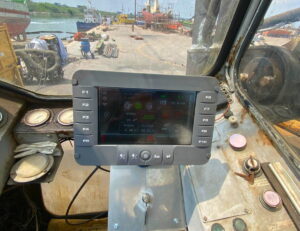 Several key factors make this type of intervention necessary:
- Electronic Component Obsolescence
Many standard monitors integrated into crane and telehandler cabs produced between 2000 and 2015 rely on LCD technology that is now obsolete. These components are often no longer supported by original manufacturers, making the OEM replacement part virtually impossible to source on the global market. - High Maintenance and Spare Parts Costs
Quite frequently, the price of a single OEM component far exceeds the market value of a current-generation rugged monitor — one that would offer substantially superior connectivity, resolution, and processing power. - Loss of Critical Safety Functionality
A screen showing internal moisture patches or a non-responsive touchscreen prevents the precise calibration of outreach limits. Such malfunctions inevitably cause forced machine downtime on site, with significant economic losses for the contractor. - Difficulty Sourcing Discontinued OEM Display Parts
When the original manufacturer has discontinued the model, finding a compatible discontinued crane display compatible with the existing on-board electronics becomes an expensive and uncertain undertaking. A custom retrofit solution eliminates this structural dependency entirely.
Rugged HMI Monitors: mechanical strength and reliability in heavy lifting
Choosing to replace the cabin display on your industrial machines with a professional rugged HMI monitor means investing in hardware specifically engineered to withstand continuous structural vibration, accidental impacts, and extreme thermal shock.
Compared to standard industrial displays, models designed specifically for the heavy lifting sector use housings manufactured from high-density die-cast aluminium and chemically toughened glass. This heavy-duty construction ensures that the display system sustains no electronic damage during operation on rough terrain or during the most demanding lifting manoeuvres, where mechanical stress is a constant factor.
These characteristics make the rugged HMI monitor for tower cranes, mobile cranes, and crawler telehandlers a technically superior choice compared to consumer or semi-industrial displays, which lack the certifications required for continuous use on construction sites.
IP67 industrial display: total protection against water, oil and abrasive dust
In mobile cranes fitted with external control stations, or in telehandlers operating in debris-saturated environments, protection against the elements is a non-negotiable technical requirement. An IP67-rated monitor provides certified hermetic sealing that completely prevents the ingress of moisture, hydraulic oil, and fine abrasive dust. During industrial display replacement, this characteristic eliminates at source the risk of internal circuit oxidation — a recurring problem with standard monitors that typically lack adequate sealing on rear connectors, which are generally the most vulnerable point to infiltration.
For the most demanding applications — quarry, demolition, or concrete environments — solutions rated to IP69K should also be evaluated. This rating guarantees resistance to high-pressure water jets during machine wash-down operations.
High-brightness outdoor monitor: maximising operational safety
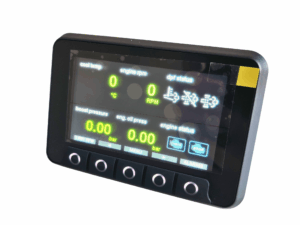
Safety in precision lifting operations depends entirely on the instant readability of data displayed on the monitor. High-brightness monitors integrate high-efficiency LED backlights exceeding 1000–1500 nits, making graphical information perfectly legible even under direct sunlight.
Integrating Optical Bonding technology into the replacement of touchscreen monitors on lifting equipment eliminates internal reflections and definitively prevents condensation from forming between the display layers. This process guarantees crystal-clear image clarity in every season and under any weather condition, from winter fog to summer glare.
Display retrofit solutions: strategic advantages of industrial display replacement
Electronic cab refurbishment through crane and earthmoving machinery display retrofit solutions allows an ageing machine to be radically rejuvenated without the need for costly structural replacement. Cabin display replacement on industrial machines should not be viewed as a simple repair of a failed function.
On the contrary, it represents an opportunity to add new diagnostic capabilities, real-time telemetry, and advanced monitoring to analogue cranes or machines fitted with now-obsolete safety systems. This intervention also enables the user interface (GUI) to be standardised across different models within a company fleet, simplifying operator workflow and significantly reducing the time required for technical staff training.
OEM Display compatibility and CAN-bus Protocol integration
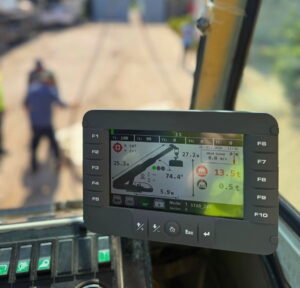
Electronic integration with the machine’s pre-existing logic is today guaranteed by modern engineering. Cabin display replacement is achieved through native support for standard industrial communication protocols including CAN-bus (J1939 and CANopen). Every critical data point captured by on-board sensors — such as actual load weight, tipping percentage, or inclination angle — is translated and displayed on the new monitor with an ultra-fast, latency-free data refresh rate, maintaining the full reliability of the original safety system intact.
Full compatibility with J1939 and CANopen protocols makes these displays suitable for replacement on Liebherr, Manitowoc, Tadano, and other manufacturers that adopt standardised on-board architectures.
Touchscreen monitor replacement for lifting machines: ergonomics and durability
Human-machine interaction now takes place predominantly through advanced tactile interfaces. PCAP (Projected Capacitive) technology represents a major leap forward in ergonomics, enabling the operator to interact with the system with extreme precision even when wearing heavy work gloves.
This specific upgrade, incorporated into crane cab display replacement, delivers superior mechanical durability compared to the old OEM plastic membranes that tended to crack under UV exposure and intensive use. The protective glass on new custom systems is engineered to withstand accidental impacts inside the cab, offering durable and transparent protection to the touch sensor beneath.
3Bmust: Specialists in Industrial Machine Cabin Display Replacement
When the original manufacturer-installed monitor is no longer repairable, too costly, or technologically inadequate, 3Bmust delivers industrial-grade hardware optimised for the global lifting market. Our company mission is to ensure that cabin display replacement is a seamless, technically impeccable, and definitive process — minimising machine downtime and the associated passive costs for the customer.
The 3Bmust Display Range: The Definitive Solution for Every Cab
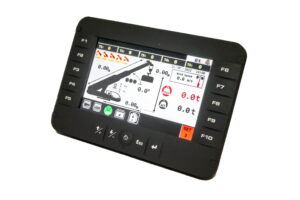 To meet the diverse needs of installation environments, 3Bmust offers a comprehensive range of industrial displays from compact 4.3-inch models through to large-format 12-inch screens, ideal for simultaneously displaying LMI data and video feeds.
TERA73Bmust is the technological benchmark for those seeking excellence in crane and telehandler retrofit. It combines a compact ergonomic design with the processing power of a next-generation processor, featuring a high-brightness display, PCAP capacitive touch, and full CAN-bus J1939/CANopen compatibility. It is the ideal choice for crane cab display replacement where maximum performance in confined spaces is required.
CANVIEW43Bmust offers an advanced solution for multi-channel visualisation or the integrated management of multiple simultaneous video streams. Designed to integrate natively with existing electronic systems, it is particularly suited to mobile cranes, aerial work platforms, and earthmoving machinery requiring 360-degree visibility during lifting manoeuvres.
Technical Advantages of 3Bmust Displays
- Advanced video integration: Many of our industrial monitors support camera input, dramatically improving rear and lateral visibility of the machine.
- Certified operating temperature range: Guaranteed performance from -30°C to +75°C, tested for operation in the most hostile worksites.
- Full IP67 protection rating: Maximum resistance to water jets and abrasive dust typical of the lifting sector.
- Programmable systems: Displays are ready to interface with COBO 3B6 replacement parts and other pre-existing control systems.
Browse our online catalogue and discover the full 3Bmust industrial display range!
Contact the 3Bmust team now and request a personalised quote for your display replacement!
FAQ: Industrial Cabin Display Replacement
How much does it cost to replace the cabin display on an industrial crane?
The cost varies depending on the model and required specifications. A custom industrial rugged monitor generally starts from a few hundred euros up to over one thousand for configurations with optical bonding, capacitive touch, and video integration. The comparison must always include the cost of avoided machine downtime and the difficulty of sourcing the original OEM part.
Is it possible to replace the display without losing LMI system compatibility?
Yes. Via CAN-bus protocol (J1939 / CANopen), the new monitor integrates natively with the load moment indicators (LMI) and stability control modules already on board, without requiring replacement of the safety electronics.
What display sizes are available for cab replacement?
Industrial cab monitors cover a range from 4.3 inches (compact displays for side panels) to 12 inches (main screens for simultaneous LMI and camera display). The choice depends on the space available in the cab and the functions to be displayed simultaneously.
What is a crane display retrofit and when is it recommended?
A crane display retrofit refers to the replacement of the original on-board monitor with a new-generation industrial display, while keeping the existing control electronics intact. It is recommended whenever the OEM monitor is discontinued, beyond repair, or no longer meets current safety standards. Retrofit is the most economical and rapid solution compared to complete electronic system replacement.

No comment yet, add your voice below!